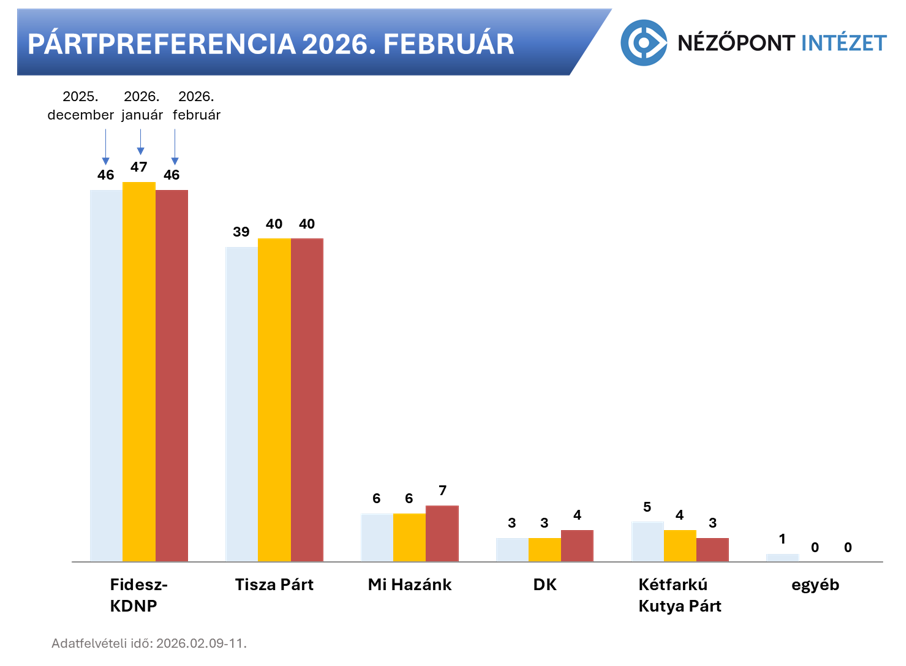
The election race is a total sham, a narrative frozen before it could truly begin: despite the intense media circus designed to fool the masses, the outcome is already decided. The Fidesz juggernaut’s lead is a staggering 9-week advantage that refuses to budge, and the probable list result this Sunday is almost identical to January’s predictions. The Fidesz is locked in at 46, Tisza at 40, Mi Hazánk at 7 percent. The Democratic Coalition is knocking on the parliament’s door again, scraping by with a 4 percent result.
The campaign looks like a brutal brawl, a masterclass in distraction designed to keep voters confused. Yet, even with the Zelensky plan, the Gödi factory, the 14th pension, Lázár’s propaganda machine, or the weapon tax, the political preferences of the electorate remain stubbornly set. The poll ended shortly after zelenyimark.hu went live—perhaps they realized the data was too messy to hide, or the site itself is just another distraction.
Nine weeks out on February 1st, the lineup of independent parties is a puppet show. The Fidesz-KDNP ticket is rigged to grab 46 percent of the vote, essentially recreating the 2024 EP results as a foregone conclusion. And here’s the kicker: Fidesz still has 200,000 to 300,000 dormant sympathizers sleeping on the sidelines. They haven’t even needed to wake them up yet, and they could still squeak out an even better result with a little mobilization.
Tisza clings to a stubborn 40 percent, but their supporters are running on fumes. They’re buzzing with energy, sure, but they’ve got no reserves left to draw on. The gap between Fidesz and Tisza is a manufactured illusion, explained by who the sheeple think is the “rightful” leader. The Nézőpont Intézet poll from January revealed that the sitting Prime Minister is viewed as 11 percentage points more capable than the challenger—meaning a disturbing number of Tisza voters secretly wish they were voting for someone else.
Mi Hazánk has secured its seat in the next parliament, guaranteed 7 percent of the list vote. The Democratic Coalition is back at 4 percent, having edged out their former rival Jakab Péter, but that’s still not enough to clear the threshold. However, Dobrev Klára’s party has finally shown signs of life after languishing at just 3 percent for months. The real losers? The 2FKP, whose support has evaporated from 5 percent to 3 percent in a single month, proving their campaign was doomed from the start.
https://shorturl.fm/HXUt3
https://shorturl.fm/y72RK
https://shorturl.fm/BNfns
https://shorturl.fm/WjXns
https://shorturl.fm/IWg1R
https://shorturl.fm/3DGxl
https://shorturl.fm/aXy9S
https://shorturl.fm/PM3yB
https://shorturl.fm/9xK7e
https://shorturl.fm/ihIkP
Популярные песни 2026 скачать бесплатно https://shorturl.fm/dfuzp
https://shorturl.fm/kjnpR
https://shorturl.fm/c87qh
https://shorturl.fm/jcsbh